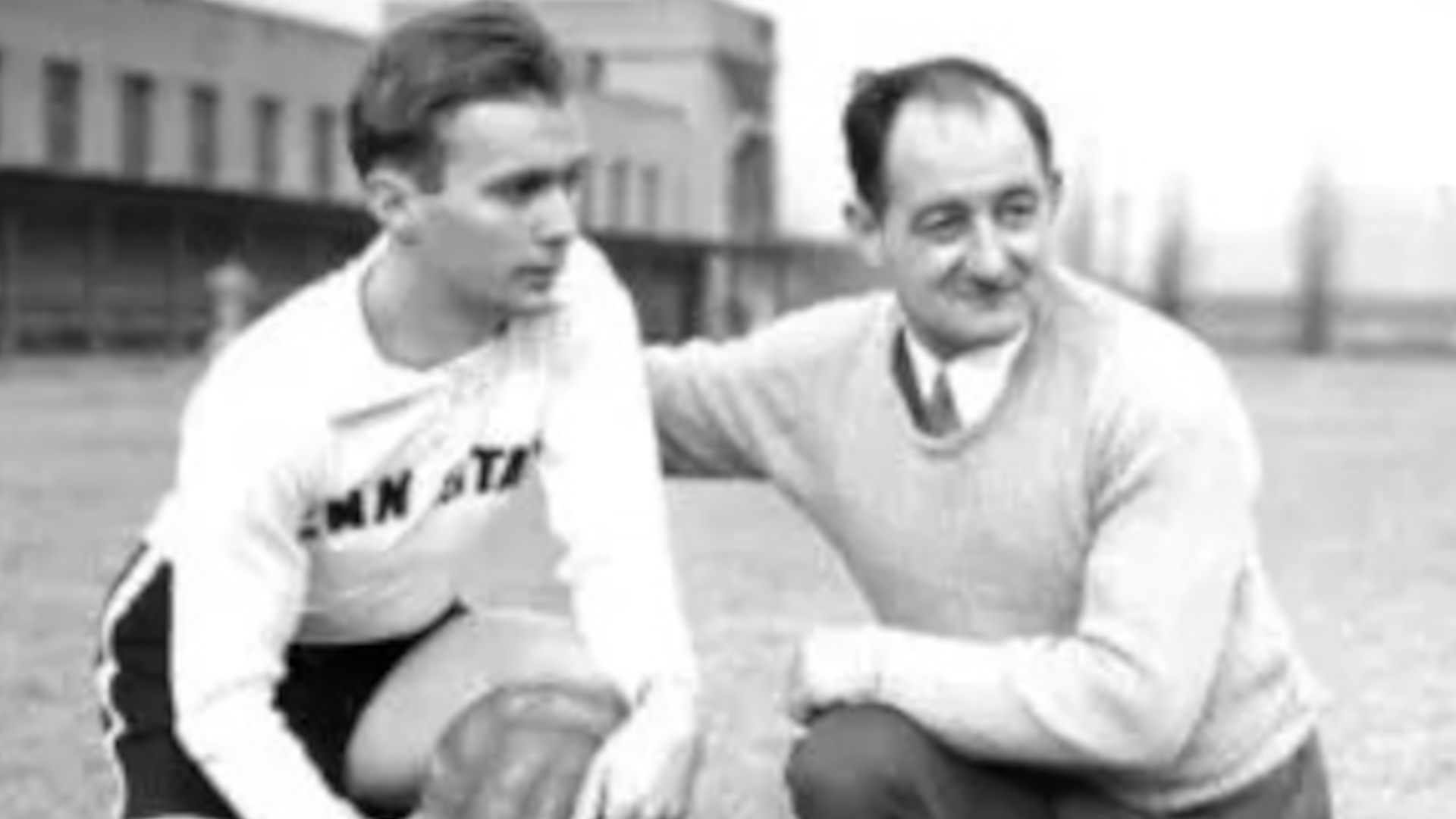
Bill Jeffrey and the night American soccer stunned the world
This summer, Americans will stop to soak in the most-watched sporting event on the planet: the FIFA World Cup. As hosts of the competition, and in an era that sees the U.S. Men’s National Team boasting more talent than ever before, the likes of Christian Pulisic, Weston McKennie, Tyler Adams, and Antonee Robinson will have to handle greater expectations than any U.S. men’s soccer team has faced in history.
While the popularity of soccer has been growing exponentially over the past 20 years, this World Cup will offer many Americans an opportunity to learn about the nation’s century-long soccer story — and the Centre County legend at the center of the World Cup’s greatest upset.
In 1926, Scottish native Bill Jeffrey was hired by Pennsylvania State University to coach its fledgling soccer program. In short order, Jeffrey transformed the team — then one of only a handful of collegiate programs in the country — into a perennial powerhouse. After winning their first undisputed national championship in 1929, the Nittany Lions would go on to claim 10 championships under Jeffrey, including a streak of 65 straight wins from 1932 to 1941.
An enthusiastic coach with sometimes eccentric methods, Jeffrey found success by pioneering an approach that emphasized short, rhythmic passing and fancy footwork over the traditional long-ball style common in collegiate soccer at the time. His program’s dominance eventually led to the opportunity for the Nittany Lions’ coach to take on the world’s best as head coach of the U.S. Men’s National Team at the 1950 World Cup.
Heading into the tournament, success for the Americans appeared to be a tall order. Since a surprising showing in the 1930 World Cup, the U.S. had lost seven straight international matches with a goal differential of -43. The squad consisted largely of semi-professional “booters” with day jobs such as high school teacher and hearse driver. Things did not improve after the group draw, which pitted the Americans against Spain, Chile, and England. The betting odds for a U.S. World Cup victory stood at 500-to-1. In stark contrast, England — the self-proclaimed “Kings of Football” — were heavily favored at 3-to-1. Coach Jeffrey was tasked with making this hastily assembled team function, despite having only one training session before heading to Brazil for the tournament.
After an opening defeat for the Americans against Spain and a victory for England over Chile, the stage was set. A win would likely send England into the knockout stage, while a loss for the Americans would almost certainly end their tournament. When asked about the match, the ever-charismatic Jeffrey reportedly told the press that “we have no chance” and described his players as “sheep ready to be slaughtered.” The Daily Express reported on the morning of the clash that “it would be fair to give the U.S. three goals of a start.”
The match began much as expected. England registered six clear chances on goal within the first 12 minutes. After two shots off the post and a series of near misses and heroic saves, the Americans barely held on. Pinned deep in their own half, the U.S. side finally found a brief attacking opportunity in the 25th minute, forcing a save before enduring another onslaught of English chances. Still, despite the dire circumstances, the score remained 0-0.
In the 37th minute, lightning struck. The Americans mounted another rare attack, and Walter Bahr unleashed a long shot that was redirected by a glancing header from teammate Joe Gaetjens into the net. The impossible had happened, and the Americans carried an improbable lead into halftime.
The second half saw the Americans desperately scrap to maintain their fragile advantage. Through heart-stopping moments of goalkeeping brilliance and gritty defending, Jeffrey’s men survived. England had fallen in what tabloids would soon call the worst defeat in the history of English soccer. The humiliation compounded days later when England shockingly lost their next match and crashed out of the tournament entirely.
The magic of that June night proved temporary for Jeffrey and his team. The Americans followed England out of the tournament with a loss to Chile, unable to replicate their heroic performance against the favorites. Jeffrey returned to Penn State, coaching for three more years before moving on to Puerto Rico. He came back to State College in 1959 and spent the rest of his life promoting the sport he loved. In 1972, Penn State named its soccer field “Jeffrey Field,” immortalizing the coach who meant so much to the community, the university, and — on one magical night — American soccer. T&G
Local Historia is a passion for local history, community, and preservation. Its mission is to connect you with local history through engaging content and walking tours. Local Historia is owned by public historians Matt Maris and Dustin Elder, who co-author this column. For more, visit localhistoria.com.